
Quantum Computing Explained: So Even A 5-Year-Old Could Get It!
Google’s revolutionary quantum chip promises to outperform classical supercomputers, solving complex problems in minutes instead of years. Could this breakthrough mark the dawn of a new era?

In 1935, Austrian physicist Erwin Schrödinger devised a thought-provoking experiment known as "Schrödinger's Cat" to illustrate the paradoxical nature of quantum mechanics, particularly the role of observation.
The thought experiment involves a cat placed in a sealed chamber along with a small amount of radioactive substance, a vial of hydrocyanic acid, a Geiger counter and a hammer. The chamber is sealed so that no one can observe what’s happening inside. If the Geiger counter detects radiation from the decay of the radioactive substance, it triggers the hammer to break the vial of hydrocyanic acid, which would kill the cat. However, until we open the box and make an observation, we will not know whether the radioactive substance has decayed ( killing the cat ) or not ( cat is still alive ).
Quantum mechanics suggests that the radioactive atom exists in a superposition of states—both decayed and not decayed—until someone observes it. This mind-bending idea means that, until you take a peek, the cat is somehow both dead and alive at the same time... let that sink in!
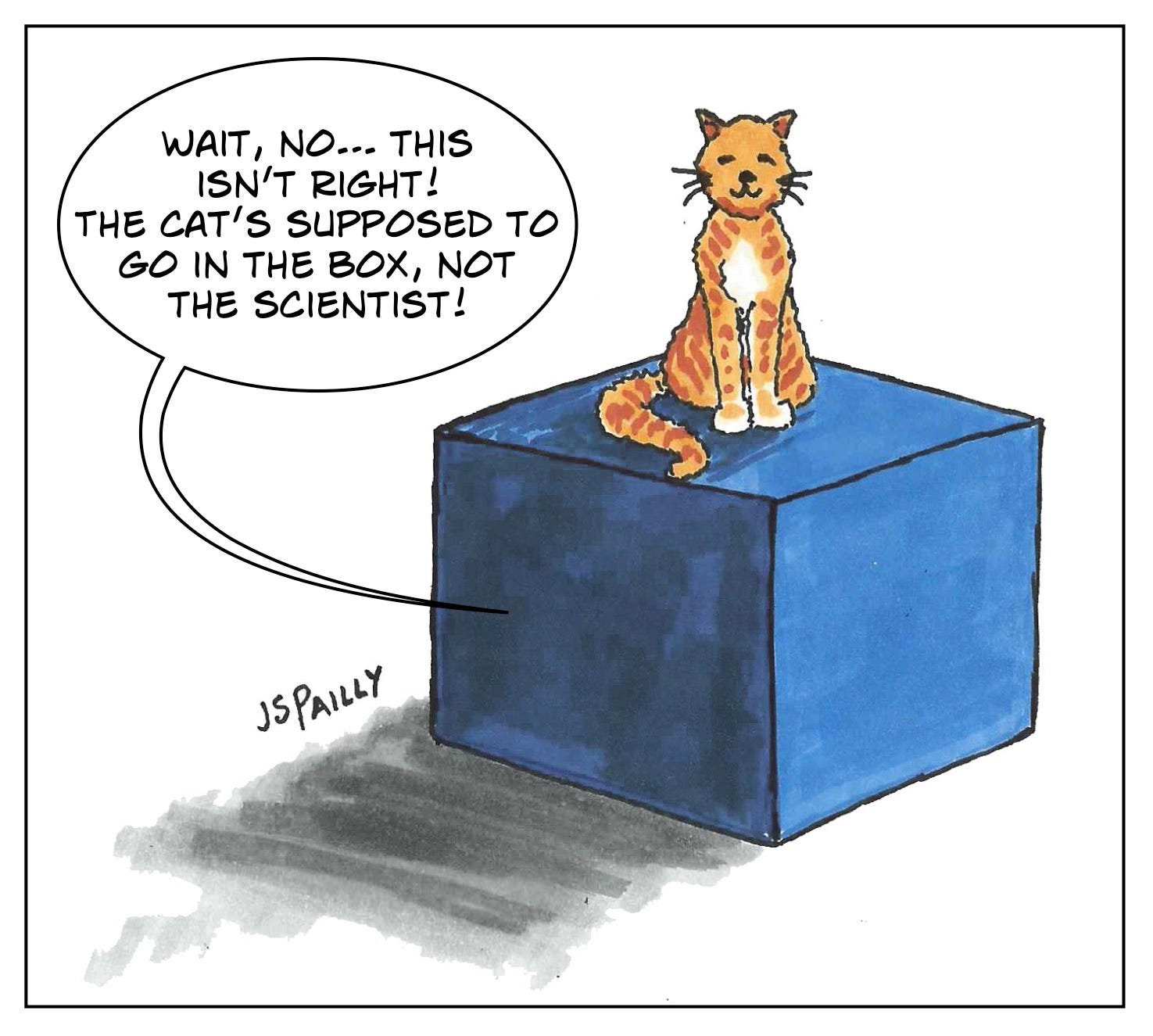
Image Credit: J S Pailly
But why am I telling you the story of a “dead” and “alive” cat?
Because the same crazy theory is behind the launch of Google’s Willow Quantum Computing chip, announced by Sundar Pichai last week:
“Introducing Willow, our new state-of-the-art quantum computing chip with a breakthrough that can reduce errors exponentially as we scale up using more qubits, cracking a 30-year challenge in the field. In benchmark tests, Willow solved a standard computation in <5 mins that would take a leading supercomputer over 10^25 years, far beyond the age of the universe(!)”
Let’s dive right in to understand how it works, and what implications it has for our future!
1. What is Quantum Computing?
Alright, let's talk about quantum computing in a way that even a 5-year-old could understand!
Imagine you have a coin in your hand. This coin can only have one state, either heads or tails at a time. This is like a regular computer - it can only track one piece of information ( 0 or 1 ) at a time.
Now imagine flipping a coin into the air. While it's spinning, you can’t be sure if it will land on heads or tails—it exists in a state of probability until it finally lands. In quantum mechanics, this is like saying the coin is both heads and tails at the same time. Similarly, a quantum computer uses units of information called 'qubits,' which can exist as both heads and tails simultaneously, unlocking extraordinary computing power.
To understand quantum computing, there are three concepts you need to really understand:
1.1 Qubits
In classical computing, the basic unit of information is the bit, which can be either 0 or 1. In contrast, a qubit can be 0, 1, or both at the same time due to a phenomenon called superposition. This means a qubit can represent a combination of all possible configurations, exponentially increasing the computational possibilities.
1.2 Superposition
Superposition allows a qubit to exist in a weighted combination of 0 and 1 simultaneously. Imagine the coin flipped in air that can be both heads and tails at the same time. When multiple qubits are combined, the number of possible states grows exponentially. For example, two qubits can process four pieces of information, three qubits can process eight, and so on.
1.3 Entanglement
Another key concept is entanglement, where the states of multiple qubits become deeply connected, no matter how far apart they are. If one qubit changes, the others instantly respond, as if they’re part of a single, unified system.
Imagine flipping 20 coins into the air—you’d expect about half to land heads and half tails. But now imagine that when the first coin lands, it somehow influences the outcomes of all the other coins still mid-air, even though they have no direct connection. This phenomenon, called entanglement, allows quantum computers to perform coordinated operations on multiple qubits simultaneously, dramatically boosting computational power and opening up entirely new possibilities for algorithms.
2. How does Quantum Computing work?
Let’s start with the simplistic explanation for 5-year old, and then we will get into deeper technical details.
Continuing our analogy of coins, when you want to solve a problem with a quantum computer, you flip multiple coins in the air at once and then let them do their magic. At the end, you measure them to get the answer. It's like asking the coins to find the right combination of heads and tails to solve a puzzle, and they can do it much faster than regular coins because they can try many combinations all at once.
But how does it work in reality - let’s find out! You can skip through to the next section if you do not care about the technical detail.
2.1 How does a quantum computer operate?
A quantum computer operates using quantum circuits, which are sequences of logical quantum operations on qubits. These operations are performed using quantum gates, the quantum equivalent of classical logic gates.
A computation on a quantum computer starts by preparing a superposition of computational states. The user designs a quantum circuit that uses operations to generate entanglement and interference between these states. A quantum computer operates using quantum circuits, which are sequences of logical quantum operations on qubits. These operations are performed using quantum gates, the quantum equivalent of classical logic gates.
2.2 How are qubits prepared and measured?
In quantum computers, the state of a qubit is represented by a mathematical object called a "quantum state vector" which describes the probability of the qubit being in each possible state. A qubit is represented as a two-dimensional vector of real numbers. This means one qubit can hold "infinitely" more information than a single regular bit.
You can think of an individual qubit as a "probability distribution" - it hovers around certain values but doesn't have a concrete value. However, when the qubit is "observed" it is forced into a vector representation of either [1, 0] representing a binary 0, or [0, 1] representing a binary 1. We call the transformation from a "probability distribution" to a concrete binary value "collapsing" the qubit.
2.3 How does a quantum computer arrive at a result?
The application of quantum gates on two qubits is effectively matrix multiplication of two vectors of real numbers. Many possible outcomes are canceled out through interference, while others are amplified. The amplified outcomes are the solutions to the computation. In quantum computation, entanglement is used to perform operations on multiple qubits in parallel, which classical computers can't do efficiently.
At the end of a quantum computation, measuring the qubits collapses their superposition to one definite state, revealing the answer. However, this measurement is probabilistic, so quantum algorithms often require running the computation multiple times to get a high probability of the correct answer.
3. What makes Quantum Computers so fast?
A quantum computer, like a regular computer, organizes information into groups of bits. For instance, a 64-bit quantum computer uses a "vector" of 64 qubits, where each qubit represents a 2D state as its basic unit of information.
Here's where the quantum speed advantage comes into play: In a regular computer, the 64 bits operate independently—they have no knowledge of or interaction with one another unless explicitly connected through a logic gate. In contrast, in a quantum computer, the 64 qubits can interact directly through a phenomenon called quantum entanglement. This entanglement allows the qubits to "communicate" and influence each other, enabling simultaneous calculations across a vast number of possibilities.
In essence, quantum computing leverages the power of entangled states and complex mathematical operations—essentially "matrix multiplication on steroids"—to solve problems at speeds far beyond what traditional computers can achieve.
Let’s take a look at two examples that illustrate how quantum computers leverage the peculiar properties of quantum mechanics to solve problems exponentially faster than classical computers, particularly for problems where an exhaustive search or factorization is involved.
3.1: Shor's Algorithm for Factoring Large Numbers
Problem: Factoring large numbers into their prime factors is crucial for breaking RSA encryption but is computationally hard for classical computers.
Quantum Advantage:
Superposition: Shor's algorithm uses superposition to perform many calculations at once. A quantum computer can try many numbers simultaneously for potential factors.
Quantum Fourier Transform: This is a quantum operation that can find the period of a function very quickly, which is key to finding factors. The quantum computer uses this to determine the period of some sequence related to the number you're factoring, which then reveals the factors.
Speedup: This process, which would take classical computers billions of years for very large numbers, can theoretically be done in seconds or minutes on a sufficiently powerful quantum computer, due to the parallel processing of quantum states.
3.2: Grover's Algorithm for Database Search
Problem: Searching an unsorted database of N items for a specific entry typically requires checking, on average, N/2 items on a classical computer.
Quantum Advantage:
Superposition: Grover's algorithm starts with a superposition of all possible database states, essentially querying all entries at once.
Amplitude Amplification: The algorithm uses quantum operations to amplify the probability amplitude of the state representing the correct answer while diminishing others. This is akin to selectively increasing the brightness of one light in a dark room to find it quickly.
Speedup: Instead of O(N) time (where you'd need to check about half the entries), Grover's algorithm finds the target in roughly O(√N) steps. For a database of 1 million entries, this reduces the search time from 500,000 checks to about 1,000 quantum steps.
4. What are practical applications of quantum computing?
Here are some scenarios where quantum computers could be super helpful:
Cryptography: Imagine you have a secret code to your treasure chest, and it's super hard to guess. Quantum computers could crack these codes much faster than regular computers.
How to Use It: You give the quantum computer the problem (like a locked treasure chest), and it tries many keys at once to find the right one. Quantum computers can break certain classical encryption algorithms but can also be used to create new, quantum-resistant encryption methods.
Finding New Medicines: Imagine searching for a key that opens a door to a room full of medicines. Quantum computers can look through all possible keys really fast to find one that matches.
How to Use It: Scientists input all the chemical possibilities, and the quantum computer checks them all at once to see which might work as a new medicine. Quantum computers can simulate the behavior of molecules, which could lead to breakthroughs in chemistry and drug discovery.
Optimizing Routes: If you're planning a trip to visit all your friends in different cities, a quantum computer can find the quickest way to do that by checking all possible routes at the same time.
How to Use It: You tell the computer where all your friends live, and it figures out the best path to visit everyone without going back and forth.
Simulating Nature: Like if you want to understand how molecules (which are tiny, tiny things) behave. A quantum computer can mimic these behaviors in a way that's too complex for regular computers.
How to Use It: Scientists input what they know about the molecule, and the quantum computer mimics its behavior, helping them learn how it works.
5. Conclusion
Quantum computers are like magical helpers that can do lots of things at once, making them great for solving really tough puzzles or exploring big mysteries in science. They're not for everyday stuff like playing games or writing emails, but for special jobs where you need to think in many directions at the same time.
So, while you might not use a quantum computer to play your favorite video game, they're out there working on big, important problems that could change the world!