

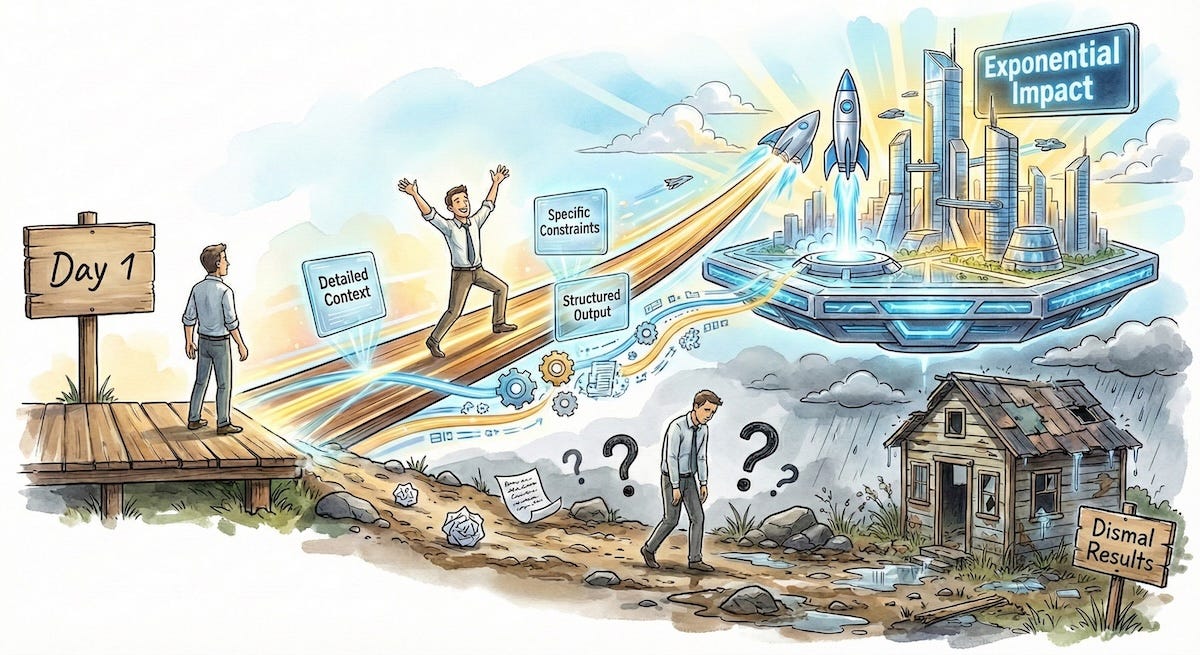
Over coffee last week, a friend—a successful executive who’s always been ahead of the curve—shared something that surprised me. “I’m worried AI is making my team lazy thinkers,” he said. “They just throw questions at ChatGPT and accept whatever comes back. Nobody’s doing the hard work of actually thinking anymore.”
I understood his concern. But then I asked him about his own experience with AI. He paused, then admitted: “Honestly? I get frustrated because I never get what I need on the first try. I end up spending more time trying to fix the output than if I’d just done it myself.”
That conversation crystallized something I’d been seeing across organizations: two completely different AI experiences, leading to two opposing conclusions about what AI does to our thinking. My friend saw his team offloading cognition and atrophying their mental muscles. But he was also experiencing something else—AI punishing him for unclear thinking.
Both observations were correct. And that’s the paradox we need to resolve.
The fear that “AI will make us dumb” misses what’s really happening: AI is not a substitute for thinking—it’s an amplifier of whatever thinking you bring to it. If your intent is fuzzy and your inputs are vague, AI will happily generate fast, confident nonsense. But if your thinking is clear and structured, it can dramatically level up the quality and speed of your work.
In a world where everyone has access to the same models, clarity of thought becomes a survival skill for leaders, not a soft skill.
The AI Paradox: Dumber or Sharper?
The debate around AI and cognition reveals two starkly different trajectories. Recent MIT research should give us pause: participants using ChatGPT showed a 47% reduction in brain connectivity compared to those using traditional search, with the weakest neural engagement of any group studied. Even more concerning, 83.3% of ChatGPT users couldn’t remember quotes from essays they had written just minutes earlier—they had essentially no memory of their own work.
When we offload writing, analysis, and decision-making to machines, it’s easy to slip into passively accepting outputs instead of actively shaping them. Over time, this reduces the “reps” we get in framing problems, weighing trade-offs, and exercising judgment—the very muscles leaders rely on in high-stakes situations.
But here’s where it gets interesting: the most effective teams using AI are experiencing the opposite effect. They’re thinking more deeply about what they want, because vague questions produce poor results and wasted time. Research shows that structured prompting processes reduce AI errors by up to 76%, with clarity in prompts reducing irrelevant results by 42%. AI becomes a mirror—it reflects back the quality of your thinking. If the question is shallow, the answer will be too.
The Calculator Moment for Knowledge Work
I remember my high school math teacher’s frustration when calculators became mandatory for our AP Calculus exam. “You won’t learn to think mathematically if a machine does the work for you,” he warned. He wasn’t entirely wrong—some of us did become sloppier with mental math. But here’s what he didn’t predict: freed from the tedium of multi-step arithmetic, we spent our cognitive energy on understanding concepts like optimization, rates of change, and modeling complex systems. We weren’t thinking less. We were thinking differently—and at a higher level.
That’s the pattern we’ve seen with every major tool that augmented human capability. When calculators became widespread, routine calculations were offloaded, and humans were freed to tackle problems in science, engineering, and finance that were previously impractical by hand. The tool didn’t make us dumber; it changed what we could afford to think about.
AI is that same leap, but for knowledge work—and the opportunity is extraordinary if we’re intentional about seizing it.
This is our chance to fundamentally upgrade the level at which we operate as leaders.
Think about how you currently spend your cognitive energy. How much goes to activities that are necessary but not transformative? Summarizing meeting notes. Reformatting presentations. Drafting routine communications. Compiling data into reports. These tasks aren’t trivial—they require care and thought—but they’re also not where you create the most value. They’re the arithmetic of leadership: essential, but not strategic.
Now imagine reclaiming that time and mental space:
What if you could spend an extra hour each day thinking about the problems that will define your organization’s future?
What if you could engage more deeply with the messy, ambiguous questions that don’t have clear answers but will shape your competitive position?
What if you had the bandwidth to mentor your team more thoughtfully, to see patterns others miss, to connect ideas across domains in ways that spark genuine innovation?
93% of workers believe AI allows them to focus on higher-level responsibilities like strategy and problem-solving. But that only happens if we’re clear about the trade we’re making: we’re not using AI to think less, we’re using it to think bigger. We’re not delegating our judgment—we’re clearing space for more of it.
The opportunity is to upgrade what you think about—but that only works if you can clearly articulate what you’re trying to achieve.
If you can’t define the problem, you can’t delegate the solution. This is why clarity isn’t just helpful in the AI era—it’s the gateway to operating at an entirely different level.
AI Rewards Clarity and Specificity
Modern AI systems are powerful, but they’re also extremely literal. Ask a vague question and you get a plausible-sounding, generic answer; ask a precise question with clear context and constraints, and the quality of output improves dramatically.
C-suite executives now rank AI literacy as the #1 skillset, with 88% of leaders saying that helping their business speed up AI adoption is their top priority for 2025. Yet the gap between adoption and optimization remains vast. The difference? How well leaders can communicate their intent.
Consider two CEOs asking AI for help with a market entry strategy:
CEO A: “Give me a strategy for entering the European market.”
CEO B: “I need a market entry strategy for our B2B SaaS product targeting mid-market manufacturing companies in Germany and France. Our competitive advantage is real-time supply chain visibility. Prioritize: speed to first customer, regulatory compliance requirements, and partnership channels. Keep it under three pages with specific milestones for quarters 1-2. I am attaching a draft of the key bullet points that matter.”
The second prompt will generate output that’s 10x more useful—not because the AI is smarter, but because the thinking is clearer.
For leaders, this means the bar for clarity has gone up, not down. It’s no longer enough to say “give me a strategy” or “summarize this for me.” The leaders getting disproportionate value from AI are those who think in terms of: Who is this for? What decision will this inform? What does good look like in this context? What constraints really matter?
AI is not replacing structured thinking—it’s punishing the lack of it.
Resolving the Paradox
So, will AI make us dumb? It can—if we use it as an autopilot and stop practicing the skills of framing, questioning, and judging. But it can also become the greatest amplifier of human thinking we have ever had, offloading lower-order tasks so we can operate at a higher level—if we bring clarity and structure to how we use it.
In a world where AI can generate infinite answers, the real competitive advantage for leaders is not access to the models; it is the clarity of their questions and the discipline of their thinking. The leaders who thrive will be those who know exactly what they are trying to achieve, can work backwards into specific, structured inputs, and are willing to iterate until the output truly matches their intent.
Take the Next Step Now
Start with one decision today: the next time you interact with AI, pause before hitting enter. Ask yourself: “Have I articulated the why? Have I provided context? Have I specified what good looks like?”
That moment of reflection is where the amplification begins.